
That pillow weighs 500 grams, but it takes up the space of 20 T-shirts.
If you’re charging shipping purely by weight, you’re quietly bleeding money on every bulky order. Lampshades, cushions, packaging materials, gift boxes, these items look cheap to ship until the carrier invoice lands. Then reality hits.
The problem isn’t your pricing strategy. It’s the tooling. Most stores still rely on weight-based shipping, even though carriers price by volume. Native shipping setups don’t understand space, only kilograms. The result: undercharged shipping, eroded margins, and no obvious way to fix it without duct tape.
Why This Problem Exists
Most e-commerce platforms were built around weight-first shipping logic. It’s simple, predictable, and easy to explain, but it’s also wrong for a huge class of products.
Carriers don’t care how light an item is. They care about how much space it occupies. That’s why volumetric (dimensional) weight exists:
(Length × Width × Height) ÷ divisor
Platforms like WooCommerce and Shopify technically support dimensions, but they don’t give you control over how those dimensions affect pricing logic. You get either flat rates, carrier rates, or crude weight tiers.
Merchants try to patch this with shipping classes or oversized flags, but those hacks collapse the moment you have mixed carts, multiple box sizes, or products that are light and bulky. The system was never designed for spatial reasoning.
The Manual / Hacky Solutions
Option 1: Do it manually
You identify bulky SKUs, calculate an average surcharge, and bake it into a flat rate. This works until you add new products, change packaging, or sell internationally. It’s error-prone and doesn’t scale.
Option 2: Use an existing shipping plugin
Most plugins stop at weight tiers or shipping classes. Some claim “dimensional shipping,” but they either:
- Require rigid box definitions
- Ignore mixed carts
- Apply the same logic to every product
You gain complexity, not control.
Option 3: Custom code
Yes, you can write custom PHP to calculate volume, compare it to weight, and return a rate. You’ll also own:
- Maintenance across platform updates
- Edge cases at checkout
- Debugging conflicts with other plugins
It’s powerful, but it’s a long-term tax on your time.
The Clean Solution with RuleHook
RuleHook solves this by treating shipping like logic, not configuration.
Instead of choosing between weight or flat rates, you define rules based on volume, dimensions, and context, then calculate a shipping rate dynamically.
Step-by-step setup
- Create a new shipping rule in RuleHook
- Add conditions:
- Product dimensions (L × W × H)
- Or calculated volume
- Define the action:
- Custom rate calculation (e.g. volume × cost factor)
- Optional minimum or maximum cap
- Save and activate
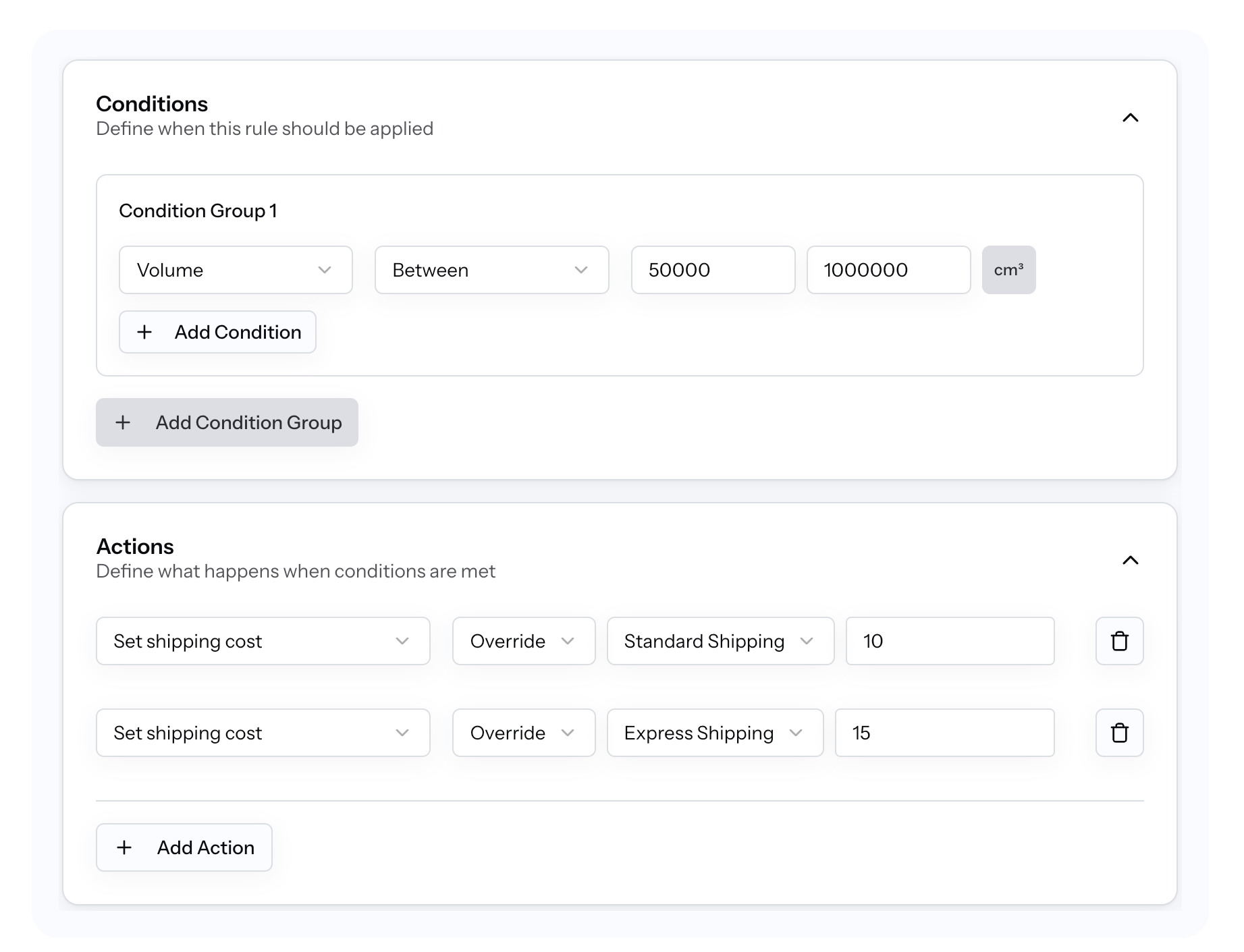
What the rule does
At checkout, RuleHook evaluates the cart:
- Detects bulky items (even if they’re light)
- Calculates the effective volumetric cost
- Returns a shipping method priced to reflect space used, not just weight
Customer experience
Nothing looks “custom” or broken:
- Customers see a normal shipping option
- Pricing feels fair and consistent
- No surprise surcharges post-checkout
Behind the scenes, you’ve aligned your checkout pricing with how carriers actually bill you.
This also works with mixed carts. RuleHook evaluates the whole order, not just individual products. Pillows + T-shirts? Still accurate.
Edge Cases to Consider
When this might not work
- If your carrier contract already enforces volumetric pricing automatically
- If all products ship in standardized, identical boxes
Other conditions to combine
- Cart total (e.g. absorb volumetric cost over €150)
- Destination zone (domestic vs international)
- Product tags (bulky + fragile logic)
Summary
Volumetric shipping isn’t an edge case, it’s the reality of modern fulfilment. If you’re selling light but bulky products, weight-based pricing guarantees margin loss.
RuleHook lets you price shipping the same way carriers do: based on space, logic, and real-world cost. No hacks. No brittle code. Just rules that make sense.
If you’ve ever looked at a shipping invoice and thought, “This should’ve been charged at checkout”, this is the fix.
Try RuleHook free for 7 days and stop subsidizing bulky orders.