If you sell glass, ceramics, or other fragile items, you already know the math hurts. Special boxes, extra padding, double labelling, and higher breakage rates quietly eat your margins. One cracked mug doesn’t just cost you the product; it costs you reshipping, refunds, support time, and sometimes a lost customer. Yet most WooCommerce stores still charge the same shipping for a book as they do for a porcelain vase. Native WooCommerce shipping tools don’t account for packaging complexity or risk, so fragile items end up subsidized by everything else in your catalog. That’s not sustainable.
Why This Problem Exists
WooCommerce shipping is rate-centric, not product-centric. Shipping methods calculate costs based on zones, weight, totals, or flat rates, not on how difficult or risky a product is to ship.
Yes, WooCommerce has shipping classes, but they’re blunt instruments. You can increase the entire rate, but you can’t surgically say: “Only add $4 when fragile items are in the cart.”
Most store owners try to work around this by:
- Raising flat rates (hurts conversions)
- Baking costs into product prices (kills competitiveness)
- Ignoring the problem (bleeds margin quietly)
These approaches fail because fragile handling is conditional. It depends on what is in the cart, not where it’s going or how much it costs.
The Manual / Hacky Solutions
Option 1: Do It Manually
You manually adjust prices for fragile products to include packaging costs.
This breaks instantly:
- Discounts distort the math
- Bundles hide the real cost
- Customers compare prices and churn
You also lose transparency; customers don’t understand why the item is more expensive.
Option 2: Use a Generic Fee or Checkout Plugin
Some plugins add blanket fees or conditional charges, but:
- They’re not shipping-aware
- They can’t target specific shipping methods
- They often apply fees even when pickup or free shipping is used
Result: unexpected fees and angry customers.
Option 3: Custom Code
Yes, a developer can hook into WooCommerce and inject conditional fees.
But now you’re:
- Maintaining custom logic across updates
- Debugging conflicts with other plugins
- Explaining fragile PHP filters to future devs
It works… until it doesn’t.
The Clean Solution with RuleHook
This is exactly the type of problem RuleHook is built to solve: conditional shipping logic with precision.
Step-by-Step Setup
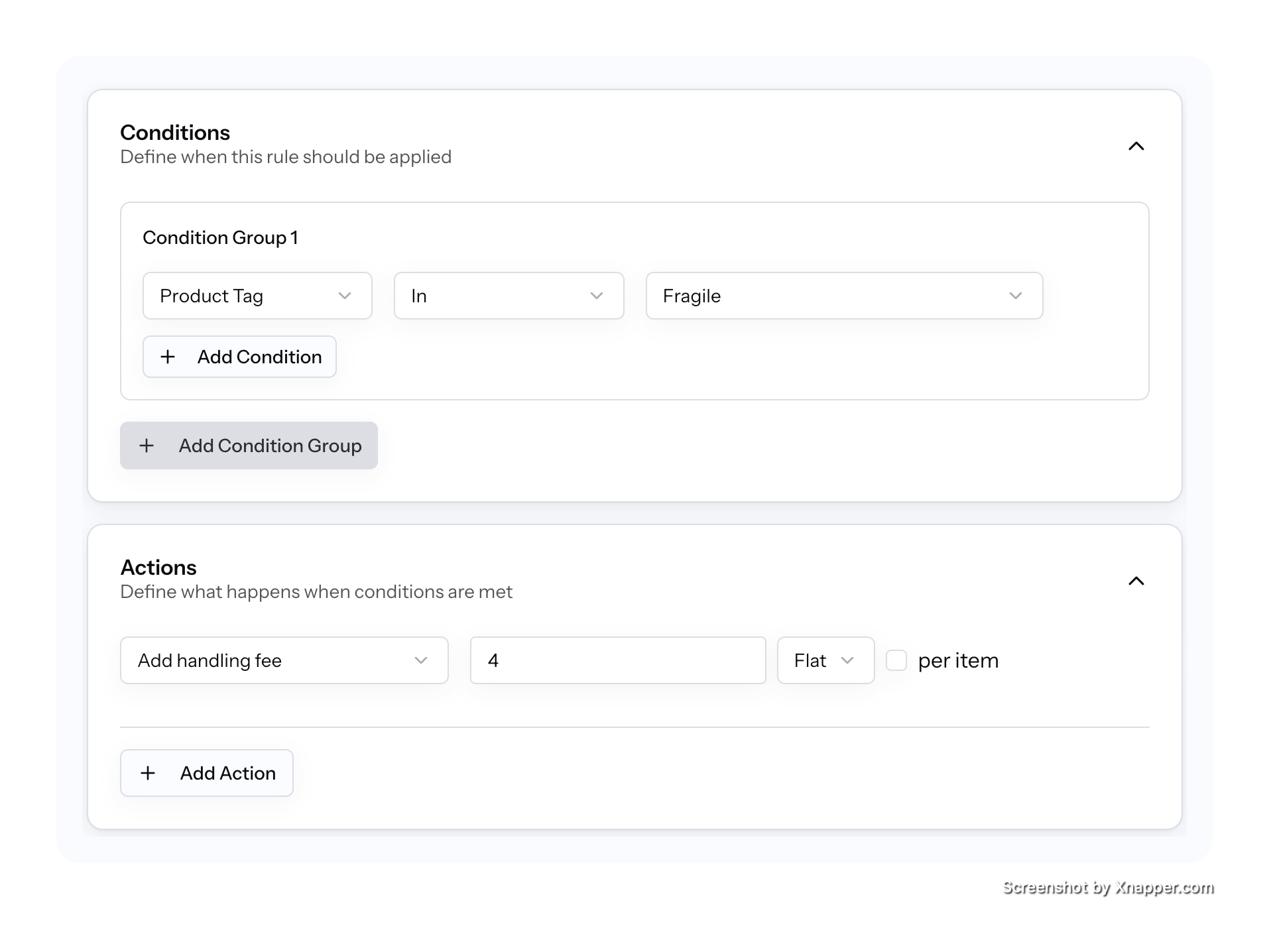
- Tag or classify your fragile products
Use a product tag likefragileor a dedicated shipping class. - Create a new Rule in RuleHook
- Condition: Product Tag =
fragile
(or Shipping Class = Fragile)
- Condition: Product Tag =
- Add an Action
- Action: Add fee
- Example: +$4 handling charge
- (Optional) Scope the rule
- Only for shipping (not local pickup)
- Only for certain zones or methods
What Happens at Checkout
When a customer adds a fragile item to the cart:
- WooCommerce calculates shipping as usual
- RuleHook evaluates the cart contents
- The handling fee is added only if the condition is met
No fragile items? No fee.
Customer Experience
The customer sees:
- A clear shipping or handling line item
- No surprises
- A logical justification for the extra cost
You protect your margins without punishing every order.
Edge Cases to Consider
When This Might NOT Work
- If all your products are fragile, a flat rate may be simpler
- If packaging cost varies wildly by size, consider combining conditions
Conditions to Combine
- Product Tag + Quantity
- Shipping Class + Weight
- Fragile + International only
Summary
Fragile items are expensive to ship; pretending otherwise is a slow leak in your business. The goal isn’t to overcharge customers; it’s to charge accurately. With RuleHook, you stop subsidizing risk, make shipping logic explicit, and protect your margins without hacks or custom code.
Try RuleHook free for 7 days and take control of shipping costs that WooCommerce was never designed to handle.
Related scenarios:
- Hide express shipping for fragile items
- Add insurance fees above a cart value
- Charge oversize handling for bulky products